
Your AI Is Smart. It Just Has No Hands
I want to describe one ordinary hour from my week, because I suspect it looks a lot like yours.
The hour
I'm building a small feature. I open my AI chat and ask for the data model. Good answer. I copy it into my editor. I tab back, ask for the API route. Also good. Copy, paste, adjust the parts that don't match my setup. Then a migration script. Ask, copy, switch.
The feature needs a short doc, so that's another tab. I paste in the summary, reformat it, correct the assumptions that aren't true for us. Someone wants the figures in a spreadsheet, so I ask for the calculations and type the results into the sheet myself. Then two slides. Another tool. Another paste.
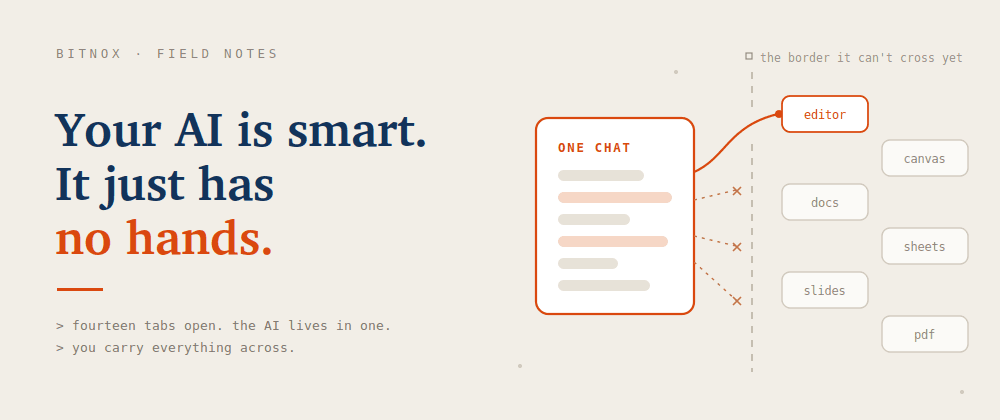
At some point I counted my open tabs. Fourteen. The AI was living in exactly one of them, giving instructions while I ran around being its hands.
What was actually wrong
None of the answers were bad. The model was sharp the entire time. The friction wasn't intelligence. It was that I had turned into a courier.
I was carrying output from the one window the AI lived in out to a dozen windows it couldn't touch. It could tell me the spreadsheet formula. It couldn't put the formula in the spreadsheet. It could write the doc. It couldn't be in the doc.
And every trip across that border cost something. Not just the seconds of copy and paste, but the thread. Each time I left the chat to go do the thing, I dropped the context. Coming back, I had to re-explain where we were. It didn't know I'd edited its code, didn't know the doc had moved on, didn't know what the last three tools had done.
The tool I use every day is an advisor, not a workplace. It's excellent at telling me things and structurally unable to do things where I actually work. We've spent three years making the advisor smarter and almost no time making it able to act.
The costs I'd stopped noticing
Context loss. The chat doesn't follow me into the editor, the doc, or the sheet. Whatever understanding we built up evaporates the moment I leave, and I rebuild it from scratch on the way back.
Fragmentation. The code, the doc, the data, the slides all end up scattered across apps that know nothing about each other. The project only exists in my head, as the thing holding the tabs together.
A blind assistant. The second I act on the advice, the AI goes dark. It can't watch me apply the suggestion, can't see the result, can't notice that I changed one line and broke something three files over. It handed me a map and then shut its eyes while I walked.
"Don't the big tools already do this?"
Fair question, and I asked it before letting myself complain. ChatGPT has Canvas. Claude has Artifacts. Gemini has its own version. They're all genuinely useful. Instead of a wall of text in the chat, you get a side panel you can work in, and some of them will run a live app right there.
But look at what they are. One surface, usually one at a time, mostly for writing or code, mostly sealed off from everything else. Canvas is a good document editor. Artifacts is a good code pane. They're modes you switch into, and when you're finished the main verb is still export. Send it to Docs. Copy the source. Download the file. Paste it where the work really lives.
The side panel made the copy shorter. It didn't remove it.
None of them is one workspace where the right surface appears on its own for whatever you're doing, in one continuous context, with the AI able to work inside each surface instead of handing you something to carry away.
What I actually wanted
One conversation that doesn't stop at the edge of the chat box. Ask for code and get an editor I work in, not a preview I copy out. Draft a doc and have the document be right there in the same session. Numbers landing in a spreadsheet the AI can fill. Slides I refine by talking. Each surface showing up because the task called for it.
There's a principle most of us already accept when building AI systems: let the model do what it's good at, which is understanding intent and reasoning about the task, then route the actual work to the tool built for that work. You don't make a language model be the spreadsheet. You let it drive the spreadsheet.
A multimodal workspace is that same principle applied to the whole product instead of a single function call.
Someone is building it
While I was chewing on this I came across a tool built around the exact idea, called Xenition. One persistent chat where the right surface opens itself: code editor, document, deck, spreadsheet, image canvas, PDF reader. It also takes the acting part seriously, with agents that carry out multi-step work behind the guardrails you'd want once an AI can actually change things. Approval gates, an audit trail, a second agent reviewing the first one's output before it reaches you.
I haven't stress-tested every corner of it and this isn't a review. But as an answer to the fourteen tabs and the blind assistant, it's the closest thing I've found to what I was describing to myself.
Where I think this goes
My honest prediction is that the next real jump won't be a smarter chat. We're deep into diminishing returns on "the model knows more." The jump will be collapsing thinking and doing into one place, so the intelligence we already have can reach the work.
Chat was the demo. It proved these models were remarkable. But a demo that makes you paste its output into fourteen other apps isn't a finished product.
So: are these tools making us productive, or giving us something new to play with? Both, and that's the problem. The reason it still feels more like play than leverage is that the intelligence sits in a chat box while the work happens somewhere it can't go. Close that gap and play quietly becomes productivity.
Which tool switch breaks your flow the most? The one copy-paste hop you make ten times a day and quietly resent? Tell me in the comments.
1 comment
Sign in to comment on this article.