
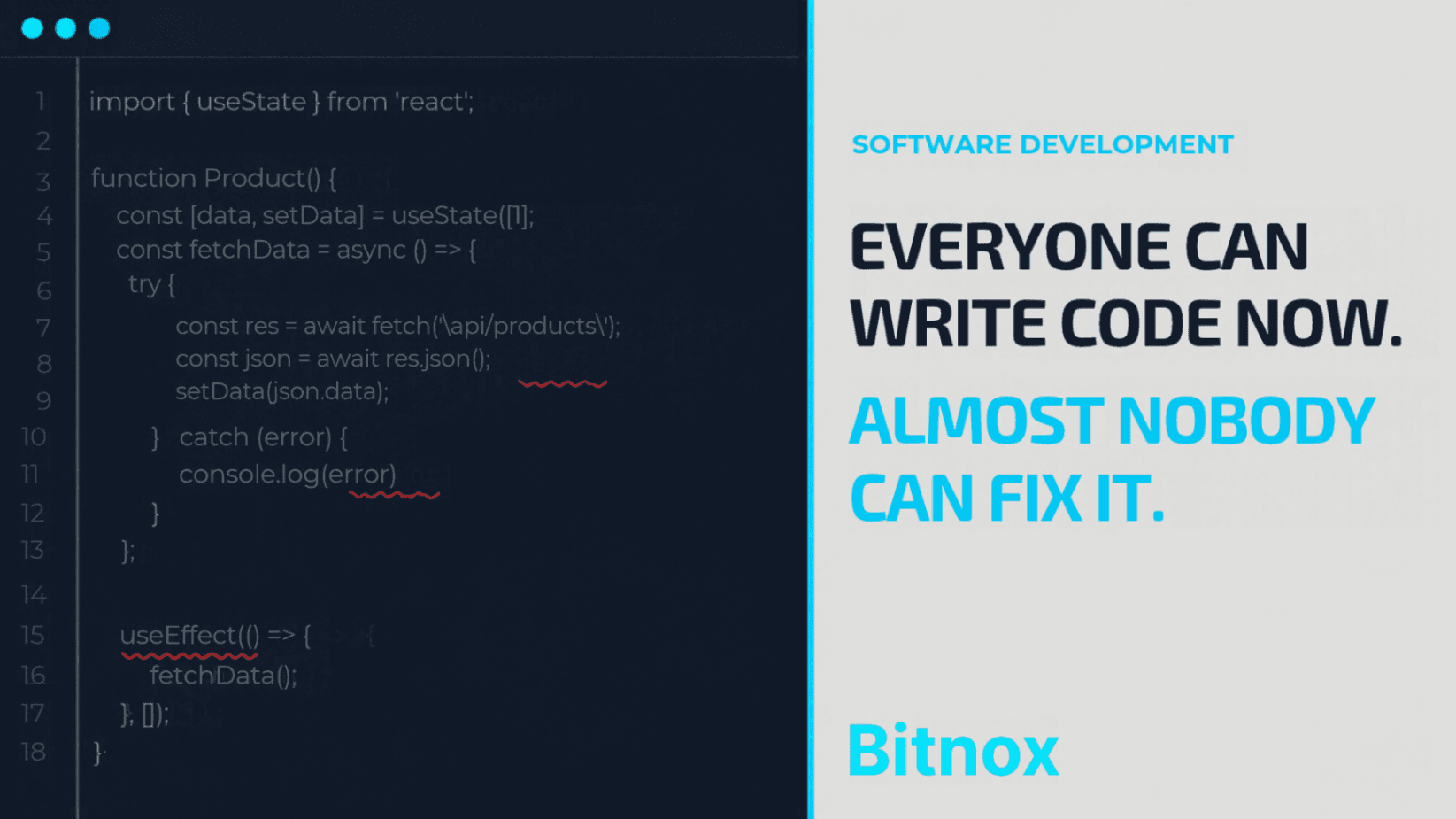
Everyone Can Write Code Now. Almost Nobody Can Fix It
A student asked me this last month, almost apologetically, as if she already knew the answer and just wanted me to confirm it: “Sir, is it not late to start learning to code? The AI is already doing it.”
It is a fair question. Three years ago, teaching someone to write a login form felt like teaching a useful trade. Today you can describe that same form in one sentence and get working code back in four seconds. If that is all programming was, then yes, the trade is finished.
But that is not what programming was, and anyone who has shipped software to real users already knows it.
The code was never the hard part
Ask any developer with a few years behind them what they actually spend their day on. It is almost never typing out fresh code. It is reading something somebody else wrote two years ago and trying to understand why it behaves strangely on the last day of the month. It is tracing a payment that was deducted but never recorded. It is sitting with a client who says the system is slow, and figuring out whether they mean the database, the network, or their own laptop.
AI has made the typing part faster. It has done almost nothing for the rest. And the rest is the job.
I have watched this play out in class. Two students use the same AI assistant on the same task. One has done the fundamentals and one has not. Within twenty minutes, the gap is embarrassing. The first student notices the generated code opens a database connection inside a loop and closes nothing. The second student does not notice, deploys it, and the application falls over the moment thirty people use it at once. Both of them “wrote” the code. Only one understood it.
You cannot direct what you do not understand
There is a popular idea that you only need to learn how to ask the AI properly. There is some truth in it, but it collapses under any real weight.
Try this. Ask an AI to build you a system that handles school fee payments for two thousand students, with receipts, partial payments, multiple terms, and a report the bursar can defend in an audit. It will give you something. It will look convincing. Now answer a few questions about what it gave you. Where is the money recorded if the network cuts halfway through? What happens when the same parent pays twice by accident? Who can reverse a transaction, and is there a record of it?
If you cannot answer those questions, you do not have a system. You have a demo that will embarrass you in front of a client. The quality of what you get out of these tools is capped by the quality of what you are able to ask, and that ceiling is built entirely from things you had to learn the slow way.
Debugging is a skill nothing has replaced
Generated code fails differently from code you wrote yourself. When you wrote it, you remember your own reasoning, so you know where to look. When a machine wrote it, you are reading a stranger’s work with no memory of the decisions behind it.
This is precisely where beginners stall. They get code that is ninety percent correct, which is in some ways worse than code that is completely broken, because broken code announces itself. Ninety percent correct code waits. It waits until a user enters a Nigerian phone number with a country code, or until February, or until someone uploads a file with a space in the name.
Finding that last ten percent requires you to hold a model of the system in your head. That model is built by writing bad code yourself, breaking it, and repairing it. There is no shortcut into it, and no tool sells it.
The opportunity here is local and it is not being served
Walk into most businesses in Abeokuta, Ibadan or Lagos and look at how they actually run. Inventory in a hardware shop tracked in an exercise book. A school recording results in a spreadsheet that one person guards jealously because the formulas break if anyone else touches it. A logistics outfit coordinating twelve vehicles over WhatsApp.
These are not people waiting for a foreign SaaS product. They are waiting for someone who understands both their work and software, and who is close enough to be called when something goes wrong. That person has to be local, and right now there are far too few of them.
Nothing about AI changes this. If anything it widens the opening, because a single competent developer can now serve more clients than before. The constraint was never typing speed. It was understanding.
What it does to the way you think
Here is the part that is hardest to put on a CV, and the part former students mention most when they come back.
Programming forces a particular discipline on you. You learn to break a problem that feels overwhelming into parts small enough to actually attempt. You learn to question your assumptions, because the computer will not forgive one. You learn that “it should work” and “it works” are different statements, and that only one of them matters.
I have taught students who ended up in accounting, logistics and civil service roles where they have not written a line of code since graduating. Nearly all of them say the same thing: they think about problems differently now. They ask better questions in meetings. They notice when a process has a hole in it.
That does not expire when a new model is released.
So, is it too late?
No. But the goal has moved, and anyone teaching you otherwise is selling something.
Learning to code in 2026 is not about memorising syntax so you can produce it on demand. The machine is better at that and will stay better. It is about building enough understanding to judge, direct, correct and take responsibility for what gets built. It is about being the person in the room who can say, with evidence, that this will not survive contact with real users.
That person is not being replaced. That person is being paid more.
My answer to the student was shorter than this article. I told her the tools have changed what a beginner needs to learn, not whether a beginner should start. Then I gave her a piece of code with a bug in it and asked her to find it. She found it in nine minutes.
That is the job. It always was.
0 comments
Sign in to comment on this article.